














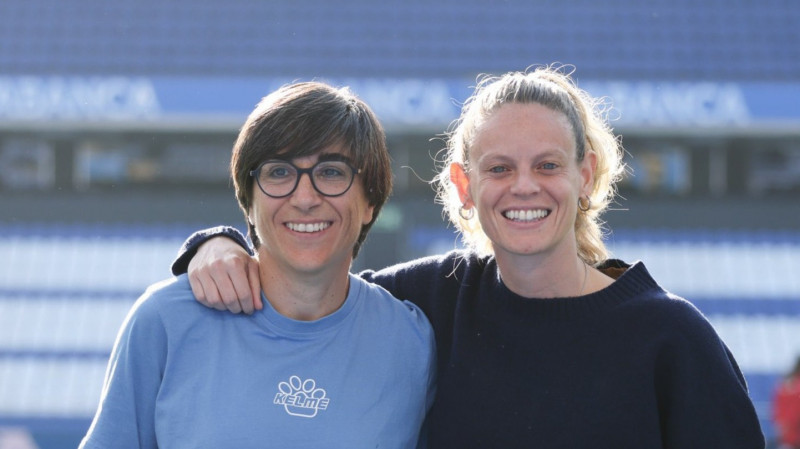
Sara Monforte and Irene Ferreras, two coaches breaking barriers on the Liga F benches
To mark International Women's Day, 8M, LigaF speaks with the only two female head coaches currently on the LigaF benches. Sara Monforte coaches RCD Espanyol, and Irene Ferreras leads Granada CF. "We need people who help women's football grow," they agree.
06 TUE 2026
The lives of Sara Monforte (Castellón, 14 October 1980) and Irene Ferreras (Fuenlabrada, 4 March 1989) have always been linked to football. The coach from Castellón started kicking a ball around in the street. She then moved through futsal and mixed football before setting up Panteras de Castellón with her friends. “We founded a team because we didn’t have one. We almost never won, but from there I was called up for the Valencian regional team, and then the Spanish national team,” she explains. Her CV includes two League titles and eight Copa de la Reina titles, six with Levante UD and two with RCD Espanyol. “For a long time, I was the player with the most Copa titles,” she replies. With twenty years of professional career behind her, the then midfielder remembers her time at DSV Colegio Alemán (formerly Valencia CF) with great affection as “the moment I changed the way I saw things because I went from winning titles to fighting for survival. Everyone should go through those situations.”
For her part, Irene Ferreras started in the reserve team of Rayo Vallecano. “It is the club of my life. The values I have received from Rayo define me now: bravery, humility, and courage. It leaves you with an essence that becomes part of you and always helps me when I face difficulties,” she affirms. In Vallecas, she won one Copa de la Reina and two Superligas, one of them with little participation because she was also in the reserves, where she was captain and also won the league. “It’s strange because I have them at home, but I never talk about them. At the time, I didn’t value them much, but now I do because winning titles is getting harder and harder,” she highlights. The Madrid native also defended the goal for Pozuelo and the reserve team of Atlético de Madrid until she retired in 2015 due to a herniated disc that forced her to stop playing, but like Sara, both wanted to remain involved in football.
“I was very clear about it, especially in the final years. I have always liked to know why one thing must be done, why another must be done, and I have really enjoyed transmitting and teaching it so that the players can better understand the game,” explains Sara Monforte, who was called by Villarreal a month after retiring at Zaragoza to put her in charge of the team. With Josep Alcácer, Luis Carrión, and Cristian Toro as her coaching role models, it was two women who placed their trust in her to lead the 'groguet' side. “I will never forget the bravery of Patri Traver and Laura Cuesta in wanting to trust me. Being women, it is much harder for them to trust us,” explains the coach from Castellón. Irene Ferreras shares this sentiment. With a degree in INEF and a coaching qualification, she started at Olímpico de Moratalaz.
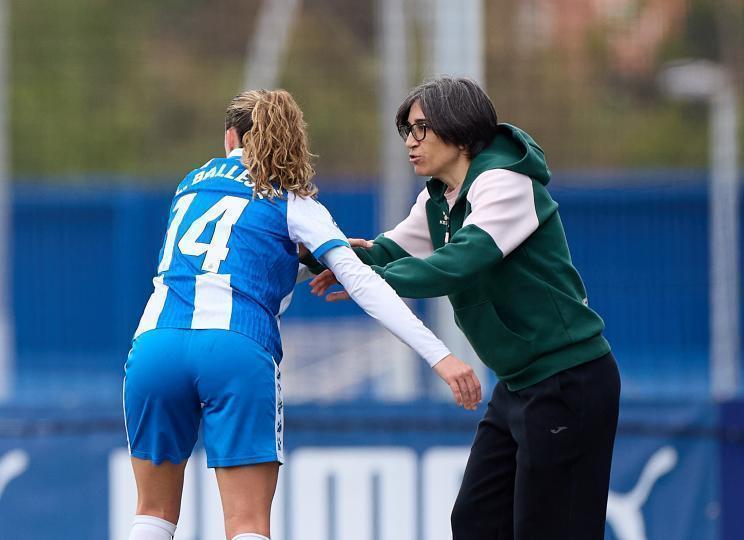
“We trained at half past nine at night and I started work at five in the morning at Decathlon,” she explains. She then moved to La Solana, where “I drove two hours to get to training, very long bus journeys...”. Until, once again, a woman appeared in her path and gave her the opportunity to coach the team of her life. “Laura Torvisco trusted me to coach Rayo Vallecano,” replies the coach from Madrid, who, when she was a player, was also influenced by the figure of Carmen Martín. “When I was a child, she would take me to and pick me up from training. I was a child watching a player-coach at Rayo and I wasn't aware that she was impacting the way I am.” A personality that led her to take the reins of the first team at Rayo Vallecano, and eventually to manage Valencia CF, where “it was the first time I had a salary to cover my basic needs.”
Both share that character and the ability to adapt to difficult situations, which has allowed both coaches to be “in a men’s sport where you care little about what they say,” explains Sara Monforte, who achieved promotion to the Primera División with Villarreal CF, keeping them in the top flight for several seasons, until, following the relegation of the Castellón side, she signed for RCD Espanyol, where, again, a woman, Dolors Ribalta, gave her the opportunity. “We should ask the sporting directors of the clubs. Gender does not define what you are as a coach. Men who have not coached women’s football are given opportunities, but no one questions whether they have experience in the women's game, yet we are not given the option to coach men’s teams,” she states. Her counterpart also coincided with another woman who changed her life again.
While serving as assistant coach at Real Madrid CF, Irene Ferreras received a call from Rocío Candal to sign for Deportivo Abanca, who were in the 1ª RFEF at the time. “She brought me into the project that changed my career,” she states emphatically. Convinced by her agent, the Madrid coach arrived in A Coruña seeking promotion. “In the summer, I argued with her a thousand times, and I even told her, ‘listen to me, I have many years of experience,’ and she replied, ‘in this part of the project, I make the decision, and in the matches, you will make the decisions,’ and we started working hand-in-hand without knowing each other at all,” highlights Irene, who achieved promotion to the Primera División two years after taking the role, although without Rocío at the club, whom she defines as “a silenced woman because she planned the promotion team.” After eleven matchdays in the top flight, she was dismissed.
This past summer, Roberto Valverde signed her to coach in the Primera again and become the first woman in history to manage Granada CF. “Before, I didn’t attach much importance to these things, but I’m excited because a woman doing something like this shows that she is breaking barriers, and we have that responsibility as role models,” she replies proudly. Precisely, the sporting director of the Nazarí side had wanted to sign Sara Monforte previously. “There are men who trust us more, but there are fewer of them,” highlights the coach from Castellón, to which Irene Ferreras adds, “he started coaching in women’s football when nobody cared. In the end, when you come from those roots, something unites you. You love football and you share that passion.” Last season, the RCD Espanyol coach was the only woman managing in Liga F Moeve for a few months.
“I didn’t feel pressure, but I felt responsibility because we have the opportunity to do this as we are representing our colleagues,” she highlights. This season, four women started on the benches in Liga F, but Emily Lima (Levante UD) and Ana Junyent (FC Badalona Women) were dismissed. “Irene and I have very similar characters because we are the survivors. We are two very demanding people who have tried to make our way in women’s football,” continues the coach of the Perico side, to which her counterpart replies that “we have adapted to very difficult situations. I have felt in my career how my failure is magnified and my success is silenced, or this season I endure an eternal comparison with the previous coach every day. We are two very tough women who haven't had things easy, and we are very clear about what our values are.”
Furthermore, Irene Ferreras is quick to shower her professional colleague with praise. “Sara is one of the best coaches we have in Spain, but she doesn't get the recognition that certain coaches might have after a good season. I see myself very reflected in her. For me, she is an example,” affirms the Granada CF coach. For her part, Sara Monforte speaks about how similarly both coaches view football. “I have had players who Irene has coached, and they tell me that I remind them a lot of Irene. In the end, we want to leave a mark on the players. That is my way of coaching,” she highlights. Additionally, the Castellón native has a dream. “I would like to coach a men’s team. They won’t give me the opportunity in the Segunda División, but perhaps in a youth team. I don’t see it today, but I do in the future, to prove that women are also capable,” she states.
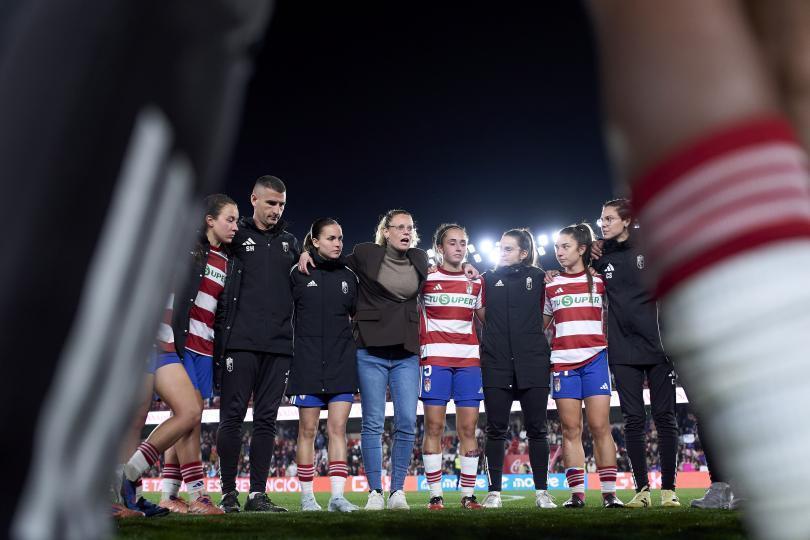
A dream shared by her counterpart at Granada CF. “I also have the aspiration to work in men’s football one day. Footballers are footballers, and you convince and help them the same way,” replies Irene Ferreras, who is very clear about why there are no women coaching in men’s football. “Because when a footballer retires, they have money, but women cannot afford to spend two or three years doing coaching courses,” she explains, although she visualises a more equal future because “when certain renowned former players start to retire, they will have more options to reach the bench relatively quickly.” For her part, Sara Monforte stresses that “they don’t trust us. It is very difficult to give an opportunity to a woman when they believe we are not capable. Changing social perception is very complicated because we are in a very sexist country.”
The coach from Castellón affirms that “the deficit comes from comparing it with men’s football because they are completely different. When you go to watch a men’s and women’s tennis match, do you look for the same thing? Alcaraz cannot be the same as Sabalenka. Just as a women’s basketball game cannot be the same as a men’s game.” An opinion that Irene shares because “we have grown up in a society where we have to be without drawing attention. A woman who stands up for herself is a problematic woman, but a man who stands up for himself is a man with personality. We are changing that, but people like Sara and I have to keep fighting.” At RCD Espanyol, there are three players with coaching potential. “I know Anna Torrodà prefers to be an assistant, but Ainoa Campo and Lucía Vallejo could be coaches,” replies Sara Monforte, who is very clear about her conclusion.
“People like Irene or myself have an obligation to help within women’s football. Think less about ourselves and more about the players. It is important to want to be here. Coaches should not look at the competition as a stepping stone, but rather that the players interpret football and become increasingly intelligent in understanding the game.” For her part, the Granada CF coach is very proud of her career because “nobody has handed me anything to get where I am now. I am very happy to look at the journey I have had and to be able to do my bit so that this grows.” Both are examples of coaches who break barriers daily, who are role models for the younger generation, and who seek “to help LigaF to raise the level every day. It is about thinking about making the league sustainable and that together we can continue to advance.”